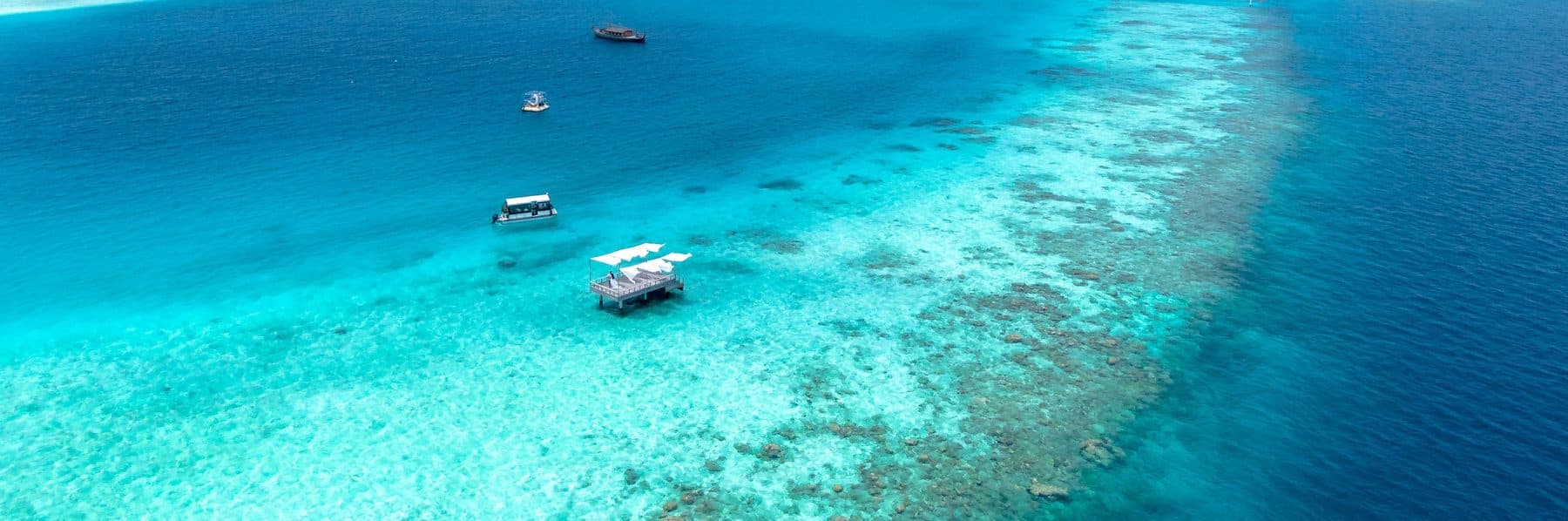
Published October 2026
This is the decision that comes before picking a resort, and it is usually framed wrongly — as though one is objectively better diving than the other. They are different kinds of diving, and the honest answer depends on what you want to see, how experienced you are, and how far you are willing to fly.
| Maldives | Caribbean | |
|---|---|---|
| Known for | Big animals — mantas, whale sharks, reef sharks | Reefs, wrecks and shore diving |
| Visibility | 20–40m, occasionally more; varies sharply by season | 20–30m+ on the southern islands, consistent year-round |
| Typical dive | Channel drifts and submerged pinnacles, often with current | Calm reefs, walls and wrecks; minimal current in places |
| Wrecks | Limited | World-class — Grenada and Curaçao especially |
| Suits | Confident divers chasing specific encounters | Beginners, mixed-ability couples, wreck divers |
| Hurricane risk | None — outside the Atlantic storm system entirely | June–November, though the southern islands sit outside the belt |
What you will actually see
The Maldives advantage is predictability with large animals. Manta rays and whale sharks are not a lucky encounter there in the right season — they are the reason the season exists. Hanifaru Bay in Baa Atoll regularly sees more than a hundred mantas feeding in a single bay, which has no real equivalent in the Caribbean. Reef sharks, turtles and napoleon wrasse are routine rather than notable.
The Caribbean trades that for variety and wrecks. Grenada is the wreck diving capital of the region, and the Superior Producer off Curaçao is regularly rated the best wreck dive in the Caribbean. You get turtles, eagle rays and healthy hard coral, plus seasonal events like coral spawning that the Maldives does not market. What you do not reliably get is a hundred mantas in one place.
The seasons work in opposite directions
This is the part most comparisons get wrong, and it matters more than anything else in planning. In the Maldives, the best visibility and the best animal encounters happen at different times of year. The northeast monsoon, December to April, gives calm seas and visibility pushing 25 to 40 metres — classic postcard conditions. But the southwest monsoon from May to November, when seas get rougher and visibility drops to 15 to 25 metres, is when plankton blooms draw in the manta and whale shark aggregations.
So you choose: clear water, or big animals. Divers who book the Maldives in February expecting mantas are often quietly disappointed, and divers who book in August and complain about visibility have misread what they signed up for.
The Caribbean has no equivalent trade-off, and the southern islands barely have a season at all. Curaçao and Bonaire sit outside the hurricane belt, with water at 26 to 28°C year-round and visibility that stays reliable regardless of month — Bonaire has never taken a direct hurricane hit in recorded history. Counterintuitively, the low tourist season from May to November on Curaçao brings the calmest seas and warmest water, so you can get better diving at lower prices by avoiding the crowds.
Conditions, and who they suit
Maldivian diving is defined by channels and submerged pinnacles with strong tidal currents — that current is exactly what brings in the big animals, but it also means drift diving with a degree of confidence required. It is a fine place to learn on a gentle house reef, and a demanding one once you move to the channels.
The southern Caribbean is the opposite. Curaçao has calm water, minimal currents and a protected marine park, with more than seventy sites reachable from shore and straightforward entries. If one of you dives and the other is learning, that difference decides it.
Getting there, and what it costs
From North America the Caribbean wins on logistics by a wide margin — a few hours in the air against the better part of a day to Malé plus a seaplane or speedboat transfer at the other end. The Maldives also carries a real price premium: mid-range dive resorts run roughly $200 to $600 a night, with ten dives adding $600 to $900 on top.
For an adults-only trip specifically, the Maldives has a structural advantage worth knowing: one island, one resort. Seclusion is built into the geography rather than being a policy the resort enforces. Caribbean adults-only resorts are larger and share their islands, so the quiet comes from how the property is run.
So which one?
Go to the Maldives if a specific encounter is the point — mantas, whale sharks, reef sharks in numbers — and you are confident enough for current. Book May to November for the animals, December to April for the water clarity, and know which you are choosing.
Go to the Caribbean if you want wrecks, shore diving, calm water, or you are travelling with someone still learning. It is cheaper, far closer, and the southern islands give you conditions that do not really have an off-season.